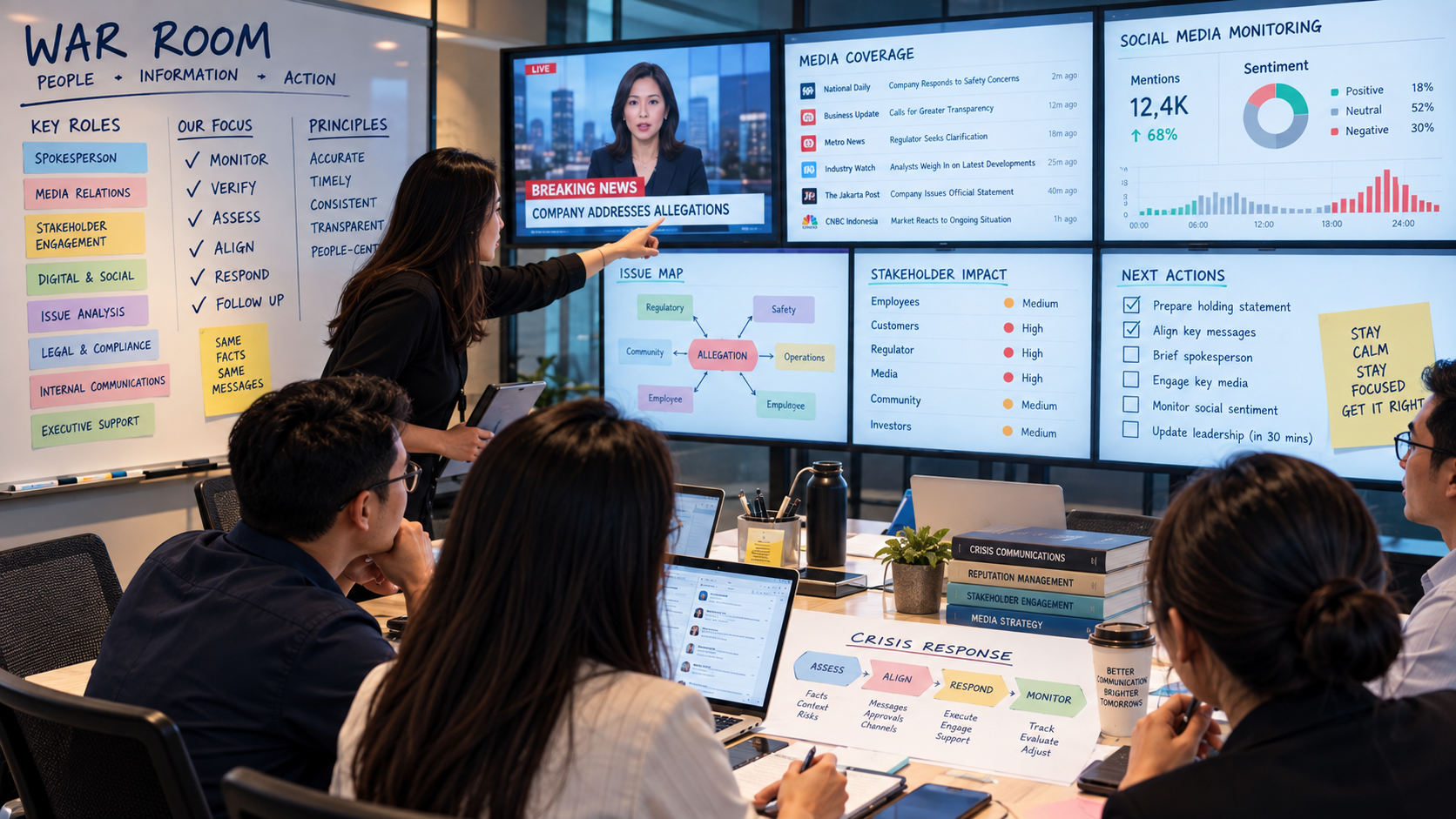
When the Situation Changes, So Must the Response
A crisis rarely arrives with complete information, a clear timeline, or a convenient set of answers.
Developments can change within minutes. Different stakeholders may demand different responses. Internal priorities can compete. And communication decisions often have to be made before the full picture is available.
A crisis plan provides a foundation. But readiness is tested when circumstances move beyond what was anticipated.
What should you prioritize when new information changes the situation?
How do you decide what needs to be communicated, to whom, and when?
How do you keep different teams aligned while the pressure builds?
And how do you make sound decisions when there is no perfect answer?
Inside the War Room: A Real-Time Crisis Communications Simulation Workshop places participants in a dynamic crisis scenario where they must assess developments, make decisions, and adapt their response as the situation unfolds.
The focus is not simply on knowing what a crisis response should look like. Participants must work through the uncertainty, competing priorities, and consequences that shape decisions in the moment.
The simulation is designed to bring the dynamics of crisis response closer to the decisions professionals may face in real organizational environments.
What Will You Learn?
The workshop focuses on the judgement required to respond when circumstances are moving faster than the information available:
What Makes This Program Different
- The Scenario Does Not Stand Still
Participants do not work from a fixed case with all the information available upfront. The scenario develops throughout the exercise, requiring them to revisit assumptions and adjust their response.
- Choices Shape What Comes Next
The exercise makes participants consider not only what decision to make, but also what that decision may enable, constrain, or trigger next.
- Crisis Communication Is Part of a Bigger Response
The simulation reflects the reality that communication decisions are connected to operations, leadership, stakeholder expectations, internal coordination, and the wider organizational response.
- Test Your Judgment Before It Is Tested for Real
The simulation provides a controlled environment to challenge assumptions, practice decision-making, and identify areas where crisis readiness may need strengthening.
What You’ll Take Away
By the end of the workshop, participants will have:
- Firsthand experience working through a crisis scenario as it develops.
- A sharper understanding of the trade-offs involved in crisis communication decisions.
- Greater awareness of how incomplete information can affect judgment.
- Practical insights into the importance of coordination and alignment during a crisis.
- A clearer sense of how their own organization may respond when circumstances move beyond the expected.
- A stronger basis for identifying where crisis readiness can be strengthened.
Who Should Join?
This workshop is relevant for professionals who may be involved in preparing for, managing, or communicating during a crisis, including:
- Corporate Communications professionals
- Corporate Affairs professionals
- Public Affairs and Government Relations practitioners
- Crisis and Issue Management professionals
- Corporate Secretaries and management support functions
- Risk and Reputation professionals
- Sustainability and ESG professionals
- Managers and executives involved in organizational response
- Professionals and individuals interested in developing their understanding of crisis management
No prior crisis communications experience is required.